


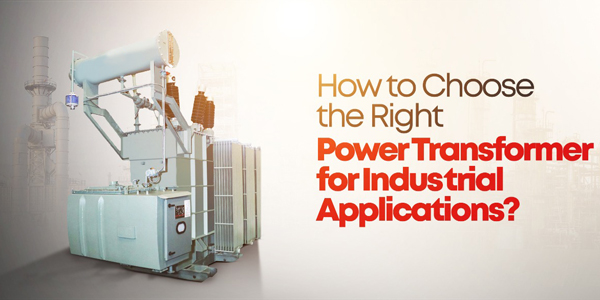
How to Choose the Right PowerTransformer for lndustrial Applications?
Choosing the right power transformer for an industrial application is a critical engineering decision that impacts safety, efficiency, reliability, and total cost of ownership. Here is a structured, step-by-step guide.
Step 1: Define Core Electrical Parameters
These are the non-negotiable technical specifications.
-
Voltage Ratings (Primary & Secondary): Determine the input (primary) voltage from your utility or generator and the required output (secondary) voltage for your equipment (e.g., 11kV/433V, 33kV/6.6kV).
-
kVA/MVA Rating (Power Capacity):
-
Calculate the total connected load of all machinery, lighting, HVAC, etc.
-
Apply diversity factor (not all equipment runs at full load simultaneously).
-
Account for future expansion (typically add 15-25% margin).
-
Choose the next standard rating above your calculated load (e.g., 500 kVA, 1000 kVA, 2.5 MVA).
-
-
Frequency: Match the system frequency (50 Hz or 60 Hz).
-
Phases: Decide between three-phase (for almost all industrial power distribution and large motors) or single-phase (for small loads, lighting, or control circuits).
-
Vector Group (Winding Connection): This defines the phase relationship and grounding. Common choices:
-
Dyn11: Most common for distribution. Delta primary (D) handles unbalanced loads, star secondary (y) provides a neutral, and ‘n’ means the neutral is brought out. The ’11’ indicates a 30-degree phase shift, standard for parallel operation.
-
Yyn0: Often used for small transformers or where a neutral is needed on both sides.
-
Dd0: Used for large industrial drives or where no neutral is required.
-
Consult standards (IEC, IEEE) and your system design engineer.
-
Step 2: Select the Appropriate Transformer Type
| Type | Best For | Pros | Cons |
|---|---|---|---|
| Liquid-Filled (Oil or Synthetic) | Most industrial applications, especially outdoors, high kVA, harsh environments. | Excellent cooling, higher overload capacity, robust, long lifespan, lower cost for large ratings. | Fire/leak risk (mitigated with less-flammable fluids), requires containment, maintenance. |
| Dry-Type (Cast Resin or VPI) | Inside buildings, mines, chemical plants, hospitals, marine, high-rise buildings. | Fire-safe (no liquid), environmentally friendly, lower maintenance, easier installation indoors. | Larger physical size for same rating, sensitive to moisture/dust if not encapsulated, higher cost for large ratings, lower overload capacity. |
| Cast Resin (a Dry-Type) | Highly corrosive, humid, or polluted environments (ports, chemical, textiles). | Extreme protection against moisture and contaminants, silent operation, minimal maintenance. | Most expensive dry-type option. |
Rule of Thumb: Outdoor substation = Liquid-filled. Indoor, close to load center = Dry-type (especially if safety/environment is paramount).
Step 3: Key Performance & Design Specifications
-
Impedance (%Z):
-
A critical parameter affecting short-circuit current and voltage regulation.
-
Standard values: ~4-6% for distribution transformers.
-
Higher %Z (e.g., 8%): Limits fault current, protects downstream equipment, but increases voltage drop.
-
Lower %Z: Better voltage regulation but much higher fault currents.
-
Must be coordinated with your overall electrical system study.
-
-
Insulation Class & Temperature Rise:
-
Defines the transformer’s thermal capability.
-
Common: Class F (155°C) insulation with a Temperature Rise of 100°C or 115°C (for liquid) or 80°C (for dry-type). This “temperature margin” ensures long life.
-
-
Efficiency & Losses:
-
No-Load Loss (Core Loss): Constant loss from magnetization. Important if transformer is always energized.
-
Load Loss (Copper Loss): Varies with load squared. Important if transformer is heavily loaded most of the time.
-
Choose based on your load profile. For 24/7 operation (e.g., a chemical plant), invest in a high-efficiency transformer (e.g., meets IEEE C57.120 or EU Tier standards). The higher initial cost is paid back through energy savings.
-
-
Taps (Tap Changers):
-
Off-Circuit Taps (OCT): For semi-permanent voltage adjustment (±2.5%, ±5%). Manual, must be de-energized.
-
On-Load Tap Changer (OLTC): Allows voltage adjustment under load. Expensive, complex, but essential for critical processes with voltage fluctuations.
-
Step 4: Consider Installation & Environment
-
Location: Indoor (room size, ventilation, fire protection) vs. Outdoor (weatherproofing, UV resistance).
-
Ambient Temperature: Affects cooling and derating. A transformer in a 45°C Middle Eastern plant cannot carry the same load as one in a 25°C Nordic facility without design adjustments.
-
Altitude: Higher altitudes (>1000m) reduce air density, requiring derating for cooling.
-
Contaminants: Dust, moisture, corrosive gases, or conductive particles may necessitate hermetically sealed (liquid) or fully encapsulated (cast resin) units.
-
Sound Level: Important for installations near offices or residential areas. Dry-types are generally quieter.
Step 5: Ancillary Equipment & Protection
-
Protection: Specify required devices: Buchholz relay (liquid-filled), pressure relief device, temperature indicators (WTI/OTI), surge arrestors.
-
Cooling: Natural Air (AN), Forced Air (AF), Water (WF) – depends on size and heat dissipation needs.
-
Enclosure: IP rating (Ingress Protection) – e.g., IP23 for outdoor (protected against rain), IP00 or IP20 for indoor switchgear.
Step 6: Standards & Compliance
Ensure the transformer is designed, tested, and certified to relevant standards:
-
International: IEC 60076 series.
-
North America: IEEE C57 series, ANSI, NEMA.
-
Local Codes: National electrical codes and safety regulations.
Decision-Making Checklist & Process
-
Gather Data: Load study, voltage levels, site conditions, single-line diagram.
-
Consult Experts: Work with a competent electrical engineer or consultant and a reputable transformer manufacturer early in the design.
-
Perform System Studies: Short-circuit, load flow, and harmonic analysis may be needed.
-
Total Cost of Ownership (TCO) Analysis: Don’t just compare purchase price. Include:
-
Initial Cost
-
Cost of Losses (over 20-30 years!)
-
Installation & Civil Works
-
Maintenance Costs
-
Reliability & Downtime Risk
-
-
Final Selection: Balance technical requirements, safety, reliability, and TCO.
Final Recommendation: For a standard heavy industrial plant, a mineral-oil or ester-fluid-filled transformer in an outdoor substation is often the most robust and economical choice. For an indoor installation in a manufacturing hall or a facility with high fire-safety requirements (e.g., pharmaceuticals, data centers), a vacuum pressure impregnated (VPI) or cast resin dry-type transformer is typically the correct and safest choice.
Always involve qualified professionals for the final design and specification.