


how to choose the right distribution transformer, prices, specs, and buying checklist
Choosing the right distribution transformer is a critical engineering and procurement decision. Here’s a comprehensive guide covering specifications, pricing factors, and a buying checklist.
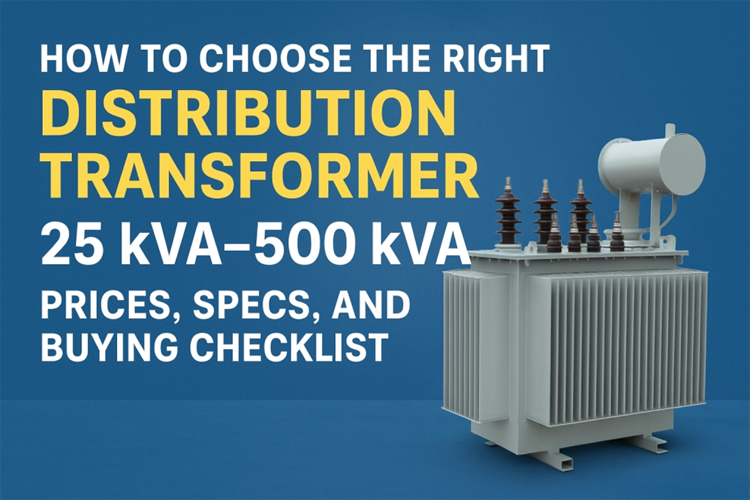
Part 1: Key Technical Specifications & How to Choose
The “right” transformer is defined by your application’s requirements. Key decisions are made here.
1. Power Rating (kVA or MVA):
-
Calculation: Determine the total connected load (kVA), apply a diversity factor (not all loads run simultaneously), and consider future expansion (typically +20-25%).
-
Formula (Simplified):
Total kVA = (Total Connected Load in kW) / (Power Factor). Choose the next standard rating above your calculated value. -
Common Standard Ratings: 50, 75, 100, 150, 225, 300, 500, 750, 1000, 1500, 2500 kVA, etc.
-
Rule of Thumb: For a residential subdivision, a 300-500 kVA padmount might serve 10-20 homes. For a commercial building, size based on the main electrical service size.
2. Voltage Ratings (Primary & Secondary):
-
Primary (HV Side): Must match your incoming utility voltage. Common in North America: 34.5kV, 27kV, 15kV, 13.8kV, 4.16kV. Rest of World: 33kV, 22kV, 11kV, 6.6kV.
-
Secondary (LV Side): Must match your facility’s distribution voltage. Common: 480Y/277V (US Commercial/Industrial), 208Y/120V (US Commercial/Residential), 400Y/230V (Europe/Asia Standard), 240/120V (US Single-Phase).
-
Critical: Confirm vector group (e.g., Dyn11, YNd1) for 3-phase transformers to ensure compatibility with your system.
3. Type & Installation:
-
Pad-Mounted (Underground): For suburban/commercial areas, placed on a concrete pad. Lockable tamper-proof enclosure.
-
Pole-Mounted (Overhead): For rural areas and overhead service lines, mounted on a utility pole.
-
Substation/Unit Substation: Larger, often dry-type or oil-filled, housed in a dedicated room or enclosure for industrial complexes or large buildings.
-
Dry-Type vs. Liquid-Filled:
-
Dry-Type: Cooled by air. Used indoors (shopping malls, high-rises, factories). Lower fire risk, environmentally benign, lower maintenance, slightly less efficient. Types: Vacuum Pressure Encapsulated (VPE) or Cast Resin (best for harsh environments).
-
Liquid-Filled: Cooled by fluid. Used outdoors or in dedicated vaults. Higher efficiency, better overload capability, longer life. Fluid Types:
-
Mineral Oil: Traditional, lower cost, but flammable.
-
Silicone (Less Flammable) or Natural Ester (FR3): Higher fire safety, biodegradable, used in sensitive environments (high-rises, parks). More expensive.
-
-
4. Impedance (%Z):
-
A measure of the transformer’s inherent resistance to fault currents. Typical range: 4% – 7% for distribution transformers.
-
Low %Z: Lower voltage drop under load, but higher fault current (requires stronger switchgear).
-
High %Z: Limits fault current but increases voltage drop.
-
Choose: Standard impedance is usually fine. Must coordinate with utility requirements and downstream protective devices.
5. Efficiency & Losses:
-
No-Load Loss (Core Loss): Constant loss whenever the transformer is energized. Affects your fixed energy cost.
-
Load Loss (Copper Loss): Varies with the square of the load. Affects your variable energy cost.
-
Look for: Efficiency labels (e.g., DOE 2016 (USA), EU Tier levels). Higher efficiency transformers (e.g., EE, HEE, AHEE) cost more upfront but save significantly on electricity over a 20-30 year life. Total Ownership Cost (TOC) calculation is essential.
6. Cooling Class (for Liquid Types):
-
ONAN: Oil Natural, Air Natural. Most common for distribution. Radiators cool by natural convection.
-
ONAF: Oil Natural, Air Forced. Fans are added to radiators for higher cooling capacity in same footprint.
7. Accessories & Protection:
-
Essential: High-voltage and low-voltage bushings, grounding pads, pressure relief device.
-
Recommended: Temperature gauge (dial or digital), over-temperature alarm/trip contacts.
-
For Liquid Types: Liquid level gauge, sudden pressure relay, fault pressure relay.
-
Optional: De-energized tap changer (DETC) or Load tap changer (LTC) for voltage regulation (adds significant cost).
Part 2: Pricing Factors (2024-25 Approximations)
Prices are highly volatile and vary by region, manufacturer, and raw material costs (copper, steel). Below are very rough ballpark figures.
| Transformer Type (kVA) | Dry-Type (Pad/Indoor) | Liquid-Filled (Pad) |
|---|---|---|
| 100 kVA | $5,000 – $9,000 | $7,000 – $12,000 |
| 300 kVA | $10,000 – $18,000 | $15,000 – $25,000 |
| 500 kVA | $15,000 – $25,000 | $20,000 – $35,000 |
| 1000 kVA | $25,000 – $45,000 | $40,000 – $65,000 |
| 2500 kVA | $60,000 – $100,000+ | $80,000 – $130,000+ |
What Drives Cost Up?
-
Higher kVA Rating.
-
Higher Primary Voltage (e.g., 35kV vs. 15kV).
-
Efficiency Level: AHEE can be 30-50% more than standard.
-
Fluid Type: FR3 ester fluid adds 20-30% over mineral oil.
-
Special Features: LTC, special BIL levels, seismic ratings, corrosion-resistant finishes.
-
Brand: Premium brands (Hitachi ABB, Siemens, Eaton) vs. value brands or local manufacturers.
-
Lead Times: Standard can be 6-12 months. Expedited/rushed manufacturing adds a premium.
Part 3: Comprehensive Buying Checklist
Phase 1: Define Requirements
-
Load Calculation: Documented kVA/MVA requirement with future growth allowance.
-
Voltages: Confirm primary (HV) and secondary (LV) system voltages and vector group.
-
Location: Indoor (dry-type) or outdoor (liquid or dry)? Environmental conditions (coastal, corrosive, seismic zone, altitude)?
-
Efficiency Target: Mandatory regulatory level or higher for TOC savings.
-
Protection & Accessories: List required gauges, alarms, protection relays, and bushings (type, material).
-
Standards Compliance: List all applicable standards (e.g., IEEE C57, IEC 60076, ANSI, DOE, local utility specs).
Phase 2: Supplier & Quotation Evaluation
-
Obtain Multiple Quotes: Minimum 3 from reputable manufacturers/distributors.
-
Technical Data Sheet: Ensure every spec from Phase 1 is clearly stated in the offered quote.
-
Price Breakdown: Itemize transformer, accessories, shipping, taxes.
-
Warranty: Standard is 1-2 years. Longer warranties (e.g., 5 years) are a plus.
-
Lead Time: Confirm realistic delivery date. Factor into project schedule.
-
Manufacturer Reputation: Check references, years in business, and service network.
Phase 3: Order & Delivery
-
Review & Approve Drawings: Factory drawings (outline, electrical diagram, weight) must be reviewed and approved before manufacturing starts.
-
Witness Testing (Optional but Recommended for Critical Units): Specify if you want to witness routine tests (ratio, polarity, impedance, load loss, no-load loss, dielectric) at the factory.
-
Delivery & Installation Plan: Verify access road, crane requirements, and foundation readiness. Confirm shipping method (rail/truck) and responsibility.
-
Documentation: Ensure you will receive complete O&M manuals, test reports, and drawings with the shipment.
Phase 4: Installation & Commissioning (Post-Purchase)
-
Pre-Installation Check: Inspect for shipping damage. Check fluid level (if applicable) and tightness of connections.
-
Commissioning Tests: Perform insulation resistance test (Megger), turns ratio test (TTR), and oil dielectric test (if liquid) before energization.
-
First Energization: Follow a controlled energization procedure (e.g., using a fuse-saving scheme or inrush limiting device).
-
Post-Energization Check: Listen for unusual sounds, check for leaks, and monitor temperatures.
Final Recommendation
-
Engage Early: Involve your consulting engineer, utility company, and potential suppliers during the planning phase.
-
Think Total Ownership Cost (TOC): Don’t just buy based on the lowest initial price. Calculate:
TOC = Purchase Price + Cost of No-Load Losses over life + Cost of Load Losses over life. -
Utility Coordination is Paramount: The utility must approve the specifications, especially for the primary connection, protection, and metering, before you place an order.
By systematically working through these specifications, cost considerations, and checklist items, you will select a transformer that is reliable, efficient, and cost-effective over its entire service life.