


Medium and High Voltage Transformers: Technological Evolution, Current Applications and Future Prospects
summary
This paper systematically studies the technological development history, current application status, and future trends of medium- and high-voltage transformers. By analyzing the basic principles of transformers, their technological evolution path, and the process of domestic production breakthroughs, and combining typical cases such as ultra-high-voltage transformers and intelligent transformers, it explores the key roles of medium- and high-voltage transformers in power systems, industrial sectors, and new energy applications. The research results show that China’s medium- and high-voltage transformer technology has achieved a leap from catching up to leading the world, and its ultra-high-voltage transformer technology has reached an internationally leading level. Intelligentization, digitalization, and greening have become the main development directions. This paper also proposes key areas and potential challenges for the future development of medium- and high-voltage transformer technology.
Keywords: Medium and high voltage transformers; Ultra-high voltage technology; Smart grid; Localization; Power system
Chapter 1 Introduction
1.1 Research Background and Significance
Medium and high voltage transformers, as core equipment in power systems, undertake important functions such as voltage transformation, power distribution, and system isolation. With the transformation of the global energy structure and the continuous growth of electricity demand, medium and high voltage transformers are playing an increasingly important role in improving energy efficiency, ensuring the stable operation of power systems, and promoting the consumption of renewable energy. As the world’s largest electricity consumer, China’s advancements in medium and high voltage transformer technology are of great significance for ensuring national energy security and promoting the energy revolution.
1.2 Research Objectives and Methods
This study aims to systematically review the technological development history of medium- and high-voltage transformers, analyze their current application status, and explore future development trends. Research methods include literature review, case analysis, and expert interviews. By collecting domestic and international technical data, analyzing typical engineering cases, and interviewing industry experts, a comprehensive understanding of the technical characteristics and applications of medium- and high-voltage transformers is achieved.
1.3 Scope and Structure of the Study
This study focuses on medium and high voltage transformers with voltage levels ranging from 10kV to 1000kV, covering their technical principles, design and manufacturing, operation and maintenance, and application scenarios. The report structure includes chapters such as introduction, basic principles of transformers, technological evolution, current application status, typical case analysis, future trends, and conclusions.
Chapter Two: Basic Principles of Transformers
2.1 Basic Working Principle of Transformers
A transformer is a device that uses the principle of electromagnetic induction to transform voltage. When alternating current passes through the primary winding, it generates alternating magnetic flux, forming a closed magnetic circuit in the iron core, which in turn induces an electromotive force in the secondary winding. According to the law of electromagnetic induction, the ratio of the transformer’s output voltage to its input voltage is equal to its turns ratio.
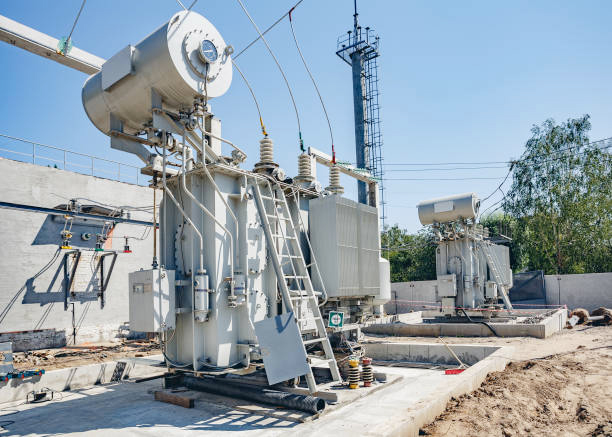
2.2 Main Components of a Transformer
Medium and high voltage transformers mainly consist of the following parts:
Iron core: It is usually made of stacked silicon steel sheets with high magnetic permeability and is used to conduct magnetic flux.
Windings: Divided into high-voltage windings and low-voltage windings, made of copper or aluminum wires.
Insulation system: including main insulation, longitudinal insulation and lead wire insulation, to ensure safe operation of equipment.
Cooling systems are divided into different types, such as oil-immersed self-cooling, forced oil circulation air cooling, and forced oil circulation water cooling.
Protection devices include gas relays, pressure relief valves, thermometers, etc.
2.3 Main performance parameters of the transformer
Rated voltage: The operating voltage specified in the transformer design.
Rated capacity: The maximum apparent power that a transformer can continuously output at rated voltage and rated frequency.
Short-circuit impedance: When a transformer is at its rated frequency, and one winding is short-circuited while the other winding is energized with voltage to bring the current to the rated value, the ratio of the applied voltage to the rated voltage.
No-load loss: The power loss of a transformer measured under no-load conditions.
Load loss: The power loss of a transformer measured at its rated current.
2.4 Transformer Testing and Inspection
Transformer testing is a crucial step in ensuring equipment performance and quality, and mainly includes:
Type testing: Conduct comprehensive performance tests on new products to verify the rationality of the design.
Routine tests: Regular tests performed on each transformer, including insulation resistance measurement, turns ratio measurement, no-load and load loss measurement, etc.
Special tests: Tests conducted to meet specific needs, such as sudden short-circuit tests and sound level measurements.
Chapter 3: Technological Evolution of Medium and High Voltage Transformers
3.1 Technological Development History
Medium and high voltage transformer technology has undergone a development process from simple to complex, and from inefficient to efficient. Early transformers used simple structures and materials. With the increase in voltage levels and capacity of power systems, transformer technology has continued to advance, resulting in various cooling methods such as self-cooling, air cooling, and forced oil circulation cooling, as well as various new insulation materials and structural designs.
3.2 Key Technology Innovation
3.2.1 Ultra-high voltage transformer technology
Ultra-high voltage (UHV) transformers are transformers with voltage levels of 800kV and above, characterized by high voltage, large capacity, and high technical difficulty. China has mastered the core technologies of UHV transformers through independent research and development, including:
UHV insulation design technology
Large-capacity transformer structural design technology
Ultra-high voltage transformer testing technology
UHV transformer manufacturing technology
3.2.2 Intelligent Transformer Technology
A smart transformer is a transformer that integrates sensors, communication modules, and intelligent control units, enabling condition monitoring, fault diagnosis, and intelligent control. The main technologies of smart transformers include:
Online monitoring technologies include dissolved gas analysis in oil, partial discharge monitoring, and temperature monitoring.
Condition assessment technology: Based on monitoring data, assess the operating status and remaining life of transformers.
Intelligent control technology: Automatically adjusts the transformer’s operating parameters according to system requirements.
3.2.3 Environmentally friendly transformer technology
Environmentally friendly transformers utilize environmentally friendly materials and processes, minimizing their impact on the environment. Key technologies include:
Environmentally friendly insulating oil: Natural or synthetic esters are used instead of mineral oil.
Biodegradable materials: Use biodegradable insulation materials and structural components.
Low-noise design: Reduce transformer operating noise by optimizing structure and materials.
3.3 Breakthrough in Domestic Production
The localization of medium and high voltage transformers in China has gone through a process from technology import to independent innovation. In the early stages, China mainly relied on imported equipment and technology. Through digestion, absorption, and reinnovation, it gradually mastered the core technologies and achieved comprehensive localization from 220kV to 1000kV voltage levels. This breakthrough in localization not only reduced equipment costs but also improved the reliability and adaptability of the equipment.
Chapter 4 Current Status of Medium and High Voltage Transformer Applications
4.1 Power System Applications
4.1.1 High Voltage Direct Current (HVDC) Transmission
High-voltage direct current (HVDC) transmission technology has advantages such as long transmission distance, large capacity, and low loss, and is widely used in long-distance, high-capacity power transmission. Medium and high-voltage transformers in HVDC systems mainly function as converter transformers, realizing the conversion between AC and DC.
4.1.2 Ultra-high voltage AC (UHVAC) transmission
Ultra-high voltage AC transmission technology features high transmission capacity and reliability, making it an important means of interconnecting regional power grids. In UHVAC systems, medium and high voltage transformers primarily function as step-up and step-down transformers, realizing voltage transformation and power distribution.
4.1.3 Power Distribution Network
Medium and high voltage transformers primarily function as distribution transformers in power distribution networks, converting high-voltage electrical energy into low-voltage electrical energy for user consumption. With the development of smart grids, distribution transformers are gradually evolving towards intelligence and modularization.
4.2 Industrial Applications
4.2.1 Steel Industry
The steel industry is a major consumer of electricity, and medium- and high-voltage transformers are mainly used in steel enterprises to supply power to large equipment such as blast furnaces, converters, and rolling mills. Due to the harsh production environment in steel enterprises, high requirements are placed on the reliability and environmental adaptability of transformers.
4.2.2 Chemical Industry
The chemical industry has extremely high requirements for the stability and security of its power supply. Medium and high voltage transformers are mainly used in chemical enterprises to power large-scale chemical plants. Chemical enterprises typically require customized transformer solutions to meet specific environmental and process requirements.
4.2.3 Rail Transit
Rail transit systems have extremely high requirements for the reliability and continuity of power supply. Medium and high voltage transformers are mainly used in rail transit to supply power to traction substations. Transformers used in rail transit need to have characteristics such as high reliability, low noise, and vibration resistance.
4.3 New Energy Applications
4.3.1 Wind Power Generation
Wind power generation is characterized by fluctuations and intermittency, posing a challenge to the stable operation of the power system. Medium and high voltage transformers in wind farms are mainly used for voltage boosting and power distribution, and need to be able to adapt to the characteristics of wind power generation.
4.3.2 Photovoltaic power generation
Photovoltaic power generation also exhibits fluctuations and intermittency. Medium and high voltage transformers are mainly used in photovoltaic power plants for voltage boosting and power distribution. As the scale of photovoltaic power plants expands, the requirements for transformer capacity and reliability become increasingly stringent.
4.3.3 Energy Storage System
Energy storage systems are an important means of addressing the volatility and intermittency of new energy sources. Medium- and high-voltage transformers in energy storage systems are mainly used for power conversion and distribution. Transformers used in energy storage systems need to have the characteristics of fast response and high-efficiency conversion.
Chapter 5 Typical Case Analysis
5.1 Case Study of UHV Transformers
5.1.1 Changji-Guquan ±1100kV UHVDC Transmission Project
The Changji-Guquan ±1100kV ultra-high voltage direct current (UHVDC) transmission project is currently the world’s highest voltage level and largest transmission capacity UHVDC transmission project. This project utilizes UHVDC converter transformers to achieve long-distance, high-capacity power transmission from Xinjiang to Anhui.
5.1.2 Case Analysis
By analyzing the ultra-high voltage (UHV) transformers in the Changji-Guquan project, we can understand their design characteristics, manufacturing processes, and operational performance. This case study demonstrates China’s leading position in UHV transformer technology.
5.2 Case Study of Intelligent Transformers
5.2.1 Intelligent Transformers in Intelligent Substations
Smart substations are an important component of smart grids. Smart transformers in smart substations enable status monitoring, fault diagnosis, and intelligent control, thereby improving the automation level and operating efficiency of the substations.
5.2.2 Case Analysis
By analyzing intelligent transformers in smart substations, we can understand their online monitoring technologies, condition assessment methods, and intelligent control strategies. This case study demonstrates the role of intelligent transformers in improving the intelligence level of power systems.
5.3 Case Study of Environmentally Friendly Transformers
5.3.1 Transformers with Natural Ester Insulating Oil
Natural ester insulating oil transformers use natural esters as the insulating medium, offering advantages such as environmental friendliness, biodegradability, and good fire resistance. This type of transformer is widely used in Europe and America and is gradually being promoted in China.
5.3.2 Case Analysis
By analyzing application cases of transformers using natural ester insulating oil, we can understand the design characteristics, performance advantages, and challenges in promoting environmentally friendly transformers. This case demonstrates the potential of environmentally friendly transformers in driving the green development of the power industry.
Chapter 6: Future Trends of Medium and High Voltage Transformers
6.1 Technological Development Trends
6.1.1 Higher voltage and greater capacity
With the development of power systems, the demand for transformers with higher voltage levels and larger capacities will continue to grow. In the future, ultra-high voltage transformers with even higher voltage levels and larger capacities may emerge.
6.1.2 Intelligentization and Digitalization
Intelligentization and digitalization are important directions for the development of transformer technology. Future transformers will be more intelligent, possessing stronger state perception, information processing, and intelligent control capabilities.
6.1.3 Greening and Environmental Protection
Green and environmentally friendly technologies are an inevitable trend in the development of transformer technology. Future transformers will place greater emphasis on the application of environmentally friendly materials and processes to reduce their impact on the environment.
6.2 Market Development Trends
6.2.1 Market demand growth
With the transformation of the global energy structure and the growth in electricity demand, the market demand for medium and high voltage transformers will continue to grow. In particular, the construction of power infrastructure in developing countries will bring huge demand for transformers.
6.2.2 Market Competition Landscape
The global medium- and high-voltage transformer market is highly competitive, with major players including Siemens, ABB, and TBEA. Future market competition will place greater emphasis on technological innovation, quality control, and customer service.
6.2.3 Market Challenges and Opportunities
The medium and high voltage transformer market faces challenges such as fluctuations in raw material prices and changes in the international trade environment, but also opportunities such as the development of new energy sources and the construction of smart grids.
6.3 Policy and Standards Development Trends
6.3.1 Policy Support
Governments around the world have introduced policies to support the development of transformer technology, including R&D funding, tax incentives, and market access. The Chinese government, through policies such as “Made in China 2025,” has strongly supported innovation and development in transformer technology.
6.3.2 Standards Development
International and domestic standards organizations are developing and improving standards related to transformers, including performance standards, safety standards, and environmental standards. Future standards will place greater emphasis on the integration of performance, safety, and environmental protection.
Chapter 7 Conclusion and Recommendations
7.1 Research Conclusions
Through systematic research, the following conclusions were drawn:
China’s medium and high voltage transformer technology has achieved a leap from following to leading, and its ultra-high voltage transformer technology has reached the international leading level.
Intelligentization, digitalization, and greening have become the main directions for the development of medium and high voltage transformer technology.
Medium and high voltage transformers are playing an increasingly important role in power systems, industrial sectors, and new energy applications.
7.2 Development Recommendations
Based on the research findings, the following recommendations are made:
Increase R&D investment and continuously promote technological innovation in medium and high voltage transformers.
Strengthen international cooperation and enhance the international influence of China’s transformer technology.
Improve the standards system to guide the healthy development of the transformer industry.
We emphasize talent development and provide talent support for the transformer industry.