


Oil-Immersed Transformer vs Dry-Type Transformer
In the world of electrical power distribution and industrial applications, transformers are fundamental components that adjust voltage levels to meet specific needs. Among the various types, oil-immersed transformers and dry-type transformers represent the two dominant technologies, each with distinct operational principles, advantages, and ideal use cases. Choosing between them is a critical decision that impacts safety, efficiency, maintenance, and total cost of ownership. This guide provides a detailed comparison to help engineers, facility managers, and project planners make an informed choice based on their specific requirements.
1.What is a Transformer?
A transformer is a static electrical device that transfers electrical energy between two or more circuits through electromagnetic induction. Its primary function is to step up (increase) or step down (decrease) alternating current (AC) voltage levels while maintaining the frequency. This capability is essential for efficient long-distance power transmission at high voltages and safe local distribution at lower voltages. The core components include a magnetic core and two or more windings (coils). The performance and application of a transformer are largely determined by its insulation and cooling system, which is the key differentiator between oil-immersed and dry-type designs.
2.Types of Transformers Based on Cooling Method
Transformers are primarily classified by their cooling and insulation medium, which defines their construction, safety profile, and installation environment.
Oil-Immersed Transformer

The core and windings are fully immersed in a dielectric insulating oil, typically mineral oil. This oil serves a dual purpose: it acts as a highly effective electrical insulator and a coolant, transferring heat away from the core to the transformer tank’s external radiators.
Dry-Type Transformer
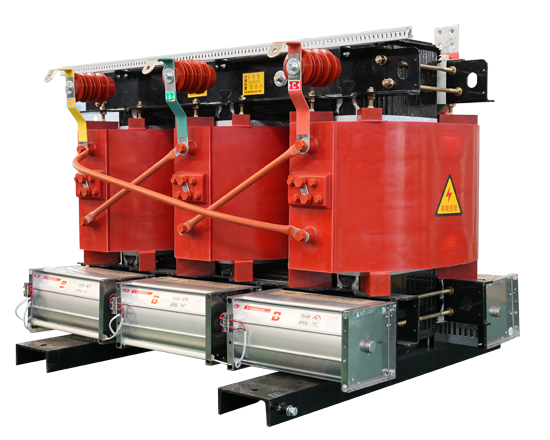
The core and windings are encapsulated in a solid insulating material (like epoxy resin or vacuum pressure impregnated varnish) or are surrounded by air. Cooling is achieved by circulating ambient air (Air Natural or Air Forced) through or over the windings, sometimes aided by fans.
The selection of cooling method dictates the transformer’s physical footprint, safety requirements, and suitability for different locations, from outdoor substations to indoor office buildings.
3.Oil-Immersed Transformers
Oil-immersed transformers are the traditional workhorses of the power grid and heavy industry, known for their high efficiency, robust construction, and excellent heat dissipation.
3.1 Operating Principle
Heat generated in the core and windings is absorbed by the surrounding dielectric oil. The heated oil circulates naturally (or is pumped) to the transformer’s external fins or radiators, where it dissipates heat to the ambient air through convection and radiation. This efficient thermal management allows for higher overload capacity and compact designs for a given power rating.
3.2 Advantages
High Efficiency and Power Capacity
The superior cooling properties of oil allow these transformers to handle very high voltages and power ratings (up to several hundred MVA) with minimal losses. They are exceptionally efficient under heavy, continuous loads.
Long Operational Lifespan
When properly maintained, the oil and paper insulation system is highly stable. These transformers routinely achieve service lives exceeding 25-30 years, making them a durable long-term asset.
Effective Overload Capability
The large thermal mass of the oil provides a significant buffer against short-term overloads without causing immediate insulation damage, offering operational flexibility.
Cost-Effectiveness for High Ratings
For medium to high voltage applications above 35 kV and ratings over 2,500 kVA, oil-immersed transformers generally have a lower initial purchase cost compared to dry-types of equivalent capacity.
3.3 Limitations
Fire and Environmental Risk
Mineral oil is flammable, posing a fire hazard, especially in case of a leak or internal fault. Modern biodegradable ester oils mitigate but do not eliminate this risk. Oil leaks can also cause soil and groundwater contamination.
Regular Maintenance Requirements
The oil condition must be monitored and periodically tested for dielectric strength, moisture content, and dissolved gases. Oil may need filtering or replacement over time, adding to lifecycle costs.
Installation Restrictions
Due to the fire risk, installation indoors or in populated areas requires expensive protective measures such as fire-rated transformer vaults, catchment pits (for oil spills), and sophisticated fire suppression systems.
3.4 Common Applications
-
Utility Power Transmission and Distribution: The backbone of electrical grids for stepping voltage up/down at generation plants, transmission substations, and distribution poles.
-
Heavy Industrial Plants: Foundries, steel mills, chemical plants, and large manufacturing facilities with dedicated outdoor or well-protected substations.
-
Renewable Energy Farms: Large-scale wind and solar farms where transformers are located outdoors and connected to the high-voltage grid.
-
Railway Traction Systems: Used in electrical railway power supply networks.
4. Dry-Type Transformers
Dry-type transformers use air or solid insulation, eliminating flammable liquids. This makes them ideal for indoor applications where fire safety, environmental concerns, and low maintenance are priorities.
4.1 Operating Principle
Heat is dissipated directly from the windings to the surrounding air. In Air Natural (AN) types, convection is passive. For higher capacities, Air Forced (AF) types use fans to blow air over the windings, enhancing cooling capacity. Advanced designs feature windings that are vacuum pressure impregnated (VPI) with insulating varnish or fully cast in epoxy resin, which provides excellent moisture resistance and mechanical strength.
4.2 Advantages
Enhanced Safety and Environmental Friendliness
With no flammable liquid, they present a significantly lower fire risk and are non-toxic. This eliminates the need for spill containment systems, making them environmentally safer.
Minimal Maintenance
They require no oil monitoring, testing, or replacement. Maintenance primarily involves keeping the unit clean and ensuring ventilation paths are unobstructed.
Installation Flexibility
Their inherent safety allows installation directly in load centers, close to the point of use within buildings—such as basements, mechanical rooms, or even on production floors—saving space and reducing costly secondary cabling losses.
High Resistance to Contamination
Cast resin transformers, in particular, are highly resistant to moisture, dust, and corrosive atmospheres, making them suitable for harsh industrial environments like mining, marine, or chemical processing areas.
4.3 Limitations
Lower Overload Capacity and Power Density
Air is a less effective cooling medium than oil. Dry-type transformers have a lower thermal inertia and are more sensitive to overloads, often requiring de-rating in high ambient temperatures. For the same power rating, they are typically larger and heavier.
Higher Initial Cost
For medium- and high-power applications, the initial cost is generally 20-40% higher than an equivalent oil-immersed unit, though this can be offset by lower installation and maintenance costs.
Acoustic Noise Level<
They tend to operate at higher audible noise levels, which can be a concern for installations near offices or residential areas, sometimes necessitating acoustic enclosures.
Sensitivity to Environment
Non-encapsulated (VPI) types can be sensitive to excessive moisture, dust, or corrosive gases, which may degrade insulation over time unless properly housed.
4.4 Common Applications
-
Commercial and Public Buildings: Shopping malls, hospitals, airports, schools, and high-rise office buildings for step-down distribution inside the premises.
-
Industrial Indoor Distribution: Manufacturing plants, assembly lines, and data centers where transformers must be located close to electrical loads.
-
Marine and Offshore Platforms: Where weight, stability, and fire safety are critical concerns.
-
Tunnels and Underground Facilities: Due to stringent fire safety regulations and limited ventilation.
-
Mining and Hazardous Locations: Where explosion-proof (Ex) designs are required.