


What’s the Point of a Distribution Transformer? A Plain-English Explanation
If you’ve ever walked down a street and noticed a grey metal can strapped to a power pole or sitting on a concrete pad behind a row of houses, you’ve seen a distribution transformer. It’s one of those things that’s easy to ignore—until it blows in a storm and your whole neighborhood goes dark.
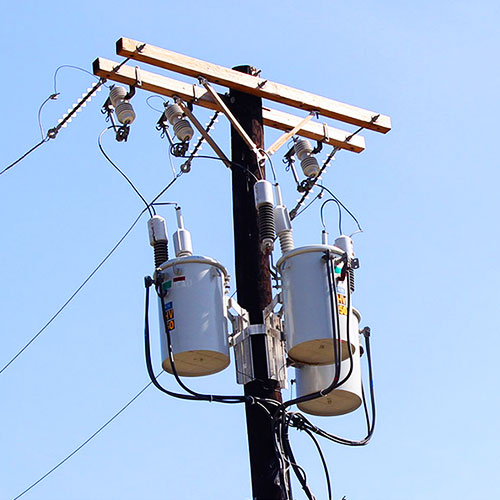
So, what does this thing actually do?
In short: it takes the high-voltage electricity running through the main power lines and turns it into the low-voltage juice that’s safe for your lights, fridge, phone charger, and toaster.
But let’s unpack that a bit.
The Big Picture: Why High Voltage in the First Place?
Power plants generate electricity at a relatively modest voltage. But to send that power across miles and miles of countryside without losing half of it as heat, utilities crank the voltage way, way up—sometimes to hundreds of thousands of volts. Think of it like a narrow pipe: if you want to push a lot of water without friction slowing it down, you increase the pressure. High voltage is that pressure for electricity.
But here’s the catch: your home isn’t built for that kind of pressure. Your wiring, your outlets, and every appliance you own expect something like 120V or 240V (depending on where you live). Plug a 13,000-volt line into your living room and you won’t just blow a fuse—you’ll vaporize the house.
That’s where the distribution transformer steps in.
The Job: Step Down, Safely
A distribution transformer has one main job: step the voltage down. It takes the medium-voltage power—typically somewhere between 2,400 and 35,000 volts—from the local distribution lines and reduces it to the 120/240 volts that actually enters your home.
It does this with no moving parts. Really. Inside that metal can is just two coils of wire (primary and secondary) wrapped around an iron core. When alternating current flows through the primary coil, it creates a magnetic field that induces a lower voltage in the secondary coil. Electromagnetic magic, pure and simple. No pistons, no gears, no oil pump. Just physics doing its job.
Why “Distribution” Matters
The word “distribution” is key here. A transmission transformer lives at the power plant or at a substation, handling enormous voltages. A distribution transformer is the last stop before your house. It’s the final step-down. It’s the workhorse that sits quietly in the heat, cold, rain, and snow, humming at 60 cycles per second, day after day, for 30 or 40 years.
Most are filled with mineral oil. That oil does two things: it cools the transformer (because those coils get hot), and it insulates the internal parts. Some newer ones use vegetable oil—better for the environment if there’s a leak.
One Transformer Doesn’t Serve Just One House
Here’s something people often get wrong: that little grey can on the pole usually feeds several houses. Not just yours. A typical residential transformer might handle 25 to 100 kilovolt-amps (kVA) and serve four to eight homes. That’s why you sometimes see one transformer blow and take out your whole block—it wasn’t just your house on that can.
So, in Plain Terms:
-
Input: High(ish) voltage from the local power lines (but not the super-high transmission stuff).
-
Output: Safe, low voltage ready for your breaker panel.
-
Method: No moving parts—just coils and a magnetic field.
-
Result: You can plug in a lamp without it exploding.
Without distribution transformers, the entire electrical grid would be useless. You can generate all the power you want and move it across the country. But until you drop that voltage down to something a light bulb can handle, you don’t have a house, a hospital, or a coffee maker—you just have a very dangerous science experiment.