


Overall application of power transformers in the energy storage industry

1. Overall Classification of the Energy Storage Industry Based on application scenarios, energy storage can be divided into five core types: power supply-side energy storage, grid-side independent energy storage, user-side industrial, commercial, and residential energy storage, microgrid off-grid energy storage, and multi-energy complementary integrated energy storage. Based on technological routes, it can be divided into four categories: mechanical energy storage, electrochemical energy storage, thermal energy storage, and hydrogen energy storage. Based on grid connection voltage levels, it can be divided into low-voltage distributed energy storage, medium-voltage centralized energy storage, and high-voltage backbone grid-connected energy storage. Under different classification models, the installed capacity, operation strategies, load fluctuation range, installation environment, and operation and maintenance management level of energy storage vary significantly, directly determining the transformer capacity selection, voltage level, structural form, insulation configuration, cooling method, and protection level.
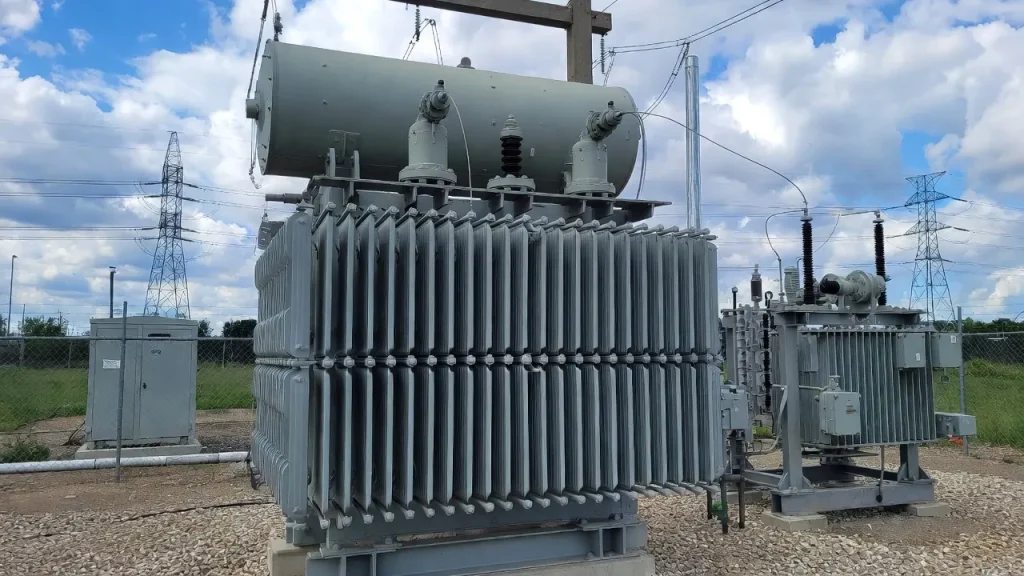
2. Transformer Applications in Power-Side Energy Storage Power-side energy storage mainly supports centralized photovoltaic power plants, distributed photovoltaic power plants, onshore wind power, offshore wind power, and other new energy projects. It is a mandatory supporting facility for new energy, and its core functions are to smooth out fluctuations in new energy power generation output, reduce peak power generation, reduce curtailment of solar and wind power, improve the grid integration and absorption capacity of new energy, and participate in the primary frequency regulation and reactive power regulation of the power grid. Power-side energy storage is generally deployed on a megawatt-scale or larger scale, and is often co-constructed and shared with new energy power plants, with unified voltage boosting, unified grid connection, and unified operation and maintenance. In this scenario, the core application forms of transformers include four types: First, low-voltage step-up transformers for energy storage units. The energy storage converter PCS outputs 0.4kV and 0.69kV low-voltage AC power, which is stepped up to 10kV or 35kV medium-voltage levels by the step-up transformer, completing the collection of power from multiple energy storage compartments and containers within the area. It is the core step-up equipment for distributed energy storage units; Second, shared collection transformers for new energy and energy storage. The wind and solar generators and energy storage systems are connected to the same medium-voltage busbar and share a single set of step-up transformer equipment. This effectively reduces equipment procurement costs, minimizes the site’s footprint, and simplifies electrical wiring and maintenance management, making it the mainstream design solution for current integrated wind, solar, and energy storage projects. Third, the site’s own distribution transformer. This step-down transformer reduces the 10kV/35kV medium voltage to 0.4kV low voltage, providing a continuous and stable power supply for the energy storage power station’s BMS battery management system, fire control system, ventilation and cooling equipment, lighting system, video surveillance, relay protection devices, and other auxiliary facilities, ensuring the basic operation of the entire station. Fourth, the high-voltage main step-up transformer. This transformer further steps up the 35kV medium-voltage power to 110kV and 220kV high-voltage transmission levels, enabling long-distance transmission of large-capacity electricity and integration into the regional main power grid. Simultaneously, it operates at reduced voltage during grid off-peak hours, providing voltage support for charging the energy storage system and achieving bidirectional energy flow. Power-side energy storage is mostly constructed in open-air environments such as deserts, mountains, hills, wetlands, coastal areas, and offshore platforms. These environments present harsh climatic conditions, including large diurnal temperature variations, strong wind and sand erosion, severe salt spray corrosion along the coast, and low air pressure at high altitudes. This places stringent demands on the transformer’s sealing performance, corrosion resistance, weather resistance, insulation margin, and anti-aging capabilities. Furthermore, the output of new energy sources is highly unpredictable, requiring energy storage systems to adjust their charging and discharging states in real time according to the generated power. Transformers operate under irregular, wide-range fluctuating loads for extended periods, leading to continuous increases in fatigue losses of windings and insulation materials. Therefore, improvements in thermal stability and mechanical durability design are essential.
3. Transformer Applications in Grid-Side Energy Storage Grid-side energy storage primarily takes the form of independent and shared energy storage power stations. Developed and constructed by power grid companies, energy groups, and independent investment enterprises, it is not tied to new energy projects and serves solely the safe and stable operation of the power grid. Its core functions encompass grid-wide peak shaving, regional voltage regulation, line power flow optimization, grid congestion mitigation, emergency backup, delaying grid expansion investment, and providing a safety net for new energy consumption. It is the core carrier for flexible regulation in the new power system. Grid-side energy storage stations typically reach scales of 100MW/200MWh and above, with high access voltage levels, large transmission power, long design lifespans, and strict safety access standards. As core primary equipment, the transformer’s reliability and stability are paramount. Core applications include: First, the 35kV energy storage aggregation transformer. This is responsible for the centralized collection of dozens of energy storage containers and prefabricated storage systems within the station, integrating dispersed energy storage units into a unified power supply module to achieve centralized control and power dispatch; Second, the 110kV/220kV main step-up transformer. As a core component of grid-side energy storage, it undertakes the task of boosting the voltage from 35kV medium voltage to high voltage grid, meeting the grid connection needs of large-capacity power. During periods of low grid load, it operates in reverse voltage reduction to charge the energy storage system, supporting bidirectional stable power flow throughout the process. Third, it serves as a reactive power compensation transformer. Working in conjunction with reactors, capacitor banks, and SVG static var generators, it achieves dynamic regulation of grid voltage and reactive power balance, suppressing grid voltage deviations and ensuring power quality meets standards. Fourth, it acts as a fault isolation transformer. In the event of short circuits, overvoltages, or lightning strikes on the grid side, its electrical isolation structure blocks the transmission of fault energy to the energy storage battery system, preventing major safety accidents such as battery thermal runaway, fires, and explosions. Grid-side energy storage transformers operate for long periods throughout the year, experience frequent load switching, and face significant short-circuit impact risks. Therefore, the design phase requires increased insulation margin, improved short-circuit impedance, and strengthened winding clamping and fixing structures to reduce the aging rate over long-term operation.
4. Transformer Applications in User-Side Energy Storage User-side energy storage covers diverse scenarios including large industrial manufacturing enterprises, industrial parks, commercial complexes, office buildings, top-tier hospitals, data centers, rail transit, and residential communities, with installed capacities ranging from tens of kilowatts to tens of megawatts. Core business logic includes peak-valley electricity price arbitrage, basic electricity demand control, emergency backup power during power outages, on-site consumption of photovoltaic power in factories, compliance with green and low-carbon energy consumption indicators, and power quality management. User-side energy storage is geographically dispersed, with a high proportion of indoor, basement, and enclosed equipment room installations. High personnel activity levels necessitate stringent requirements for fire safety, low noise, and zero pollution. Transformer applications primarily include: First, low-voltage isolation transformers. Widely used in small-scale industrial and commercial, and residential energy storage scenarios, these transformers achieve electrical isolation between the PCS converter and low-voltage loads, suppressing noise interference, preventing leakage, and improving electrical safety. Second, 10kV step-up transformers. Large-scale factory and industrial park energy storage systems step up 0.4kV low-voltage energy storage to 10kV and connect it to the enterprise’s internal high-voltage power distribution system, enabling local replenishment of internal loads and grid connection of surplus power; Third, fully dry-type distribution transformers. Suitable for enclosed urban indoor spaces, flame-retardant and fireproof, with no risk of oil leakage, meeting fire safety acceptance standards; Fourth, dual-redundant backup transformers. In primary load scenarios such as data centers, medical institutions, and transportation hubs, a dual-transformer backup mode is configured to ensure uninterrupted emergency power supply from energy storage and guarantee the safe operation of critical facilities.
5. Transformer Applications in Microgrids and Off-Grid Energy Storage Microgrids and off-grid energy storage are mainly used in islands, remote mountainous areas, field mines, communication base stations, border outposts, and agricultural and pastoral areas without grid coverage. They rely on distributed photovoltaics and small-scale wind power combined with energy storage to build independent, autonomous power supply systems that can operate in isolation from the main power grid for extended periods. In off-grid operation, the grid lacks voltage and frequency stabilization support; voltage and frequency regulation depends entirely on the coordinated control of the PCS and transformers, making the operating conditions more complex than in grid-connected mode. In this scenario, the core functions of the transformer include: long-distance power transmission voltage boosting, local low-voltage load voltage reduction, islanded voltage stabilization control, and electrical isolation of multiple energy units. Due to the remoteness of the construction areas, insufficient maintenance personnel, and scarce maintenance resources, transformers require high reliability, low failure rate, maintenance-free design, and strong environmental adaptability to reduce later maintenance and replacement costs.
6. Transformers in Special Energy Storage Sectors: Pumped storage, compressed air storage, gravity storage, and hydrogen storage are large-scale, long-duration energy storage facilities and are important components of new energy storage technologies. They also require large-capacity, high-voltage transformers for support. Pumped storage power stations have a dual-mode operation for both power generation and pumping, requiring the main transformer to adapt to periodic bidirectional power flow switching over extended periods, with voltage levels reaching 330kV and 500kV. Compressed air storage power stations experience severe load fluctuations, necessitating transformers with strong short-term overload capacity. Hydrogen production plants are high-energy-consuming, continuous loads; the addition of energy storage significantly increases the requirements for transformer energy efficiency and stable operation.