


Transformer Mounting Types: A Complete Guide to Different Installation Methods
Transformer mounting types refer to the physical methods and structures used to install transformers, each suited to specific applications, environments, and capacity requirements. The choice depends on factors such as voltage class, power rating, location (overhead vs. underground), available space, safety considerations, and cost.
Transformer mounting types
Pole-Mounted Transformers
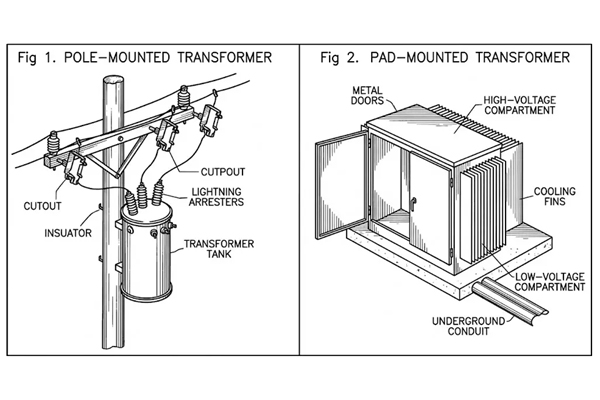
Pole-mounted transformers are mineral‑oil‑immersed units secured directly to utility poles, connected to overhead primary circuits. They are a staple of overhead distribution systems, particularly in rural and suburban areas.
-
Typical Ratings: Single‑phase units commonly range from 5 to 167 kVA, with primary voltage classes from 2.4 kV to 34.5 kV, supplying 120/240 V split‑phase secondaries. IEEE C57.12.20 covers overhead‑type distribution transformers up to 500 kVA.
-
Applications: Ideal for serving residential and light commercial loads in areas with low service density, such as rural laterals and small towns. Three single‑phase units can be banked to serve three‑phase loads for farms and light industry.
-
Advantages: Lower installed cost for sparse loads because existing poles and aerial rights‑of‑way eliminate the need for civil works and underground duct banks. They also have simpler set, lift, and tie‑in procedures using standardized hardware.
-
Disadvantages: Exposure to weather, windborne debris, lightning, and icing can cause wear and tear. Visible equipment and service drops may be considered an eyesore in denser or high‑amenity settings. Capacity is limited compared to ground‑mounted units.
Pad-Mounted Transformers
Pad-mounted transformers sit in locked steel enclosures on concrete pads at ground level. They are the standard step‑down devices for underground residential distribution (URD), commercial campuses, and light‑industrial parks.
-
Typical Ratings: Primary ratings span 2.4–46 kV, with common three‑phase kVA ratings from 45 up to 10,000. Secondaries often include 208Y/120 V and 480Y/277 V for commercial service.
-
Applications: Used where underground primary cables feed a transformer placed on a pad, serving residential, commercial, and industrial loads. They are preferred in public areas because all energized connections are securely enclosed in a grounded metal housing.
-
Advantages: Tamper‑resistant, weatherproof, and quiet, making them suitable for installations frequented by the general public. They localize medium‑voltage switching and protection near the load while keeping energized parts inaccessible. Lower purchase cost and fewer cooling issues compared to subsurface equipment.
-
Disadvantages: The locked cabinet must be secured against unauthorized entry and vandalism. Surface temperatures can approach the boiling point of water, posing a burn hazard. Sharp corners or edges may be hazardous to children at play, though standards address these concerns.
Substation Transformers
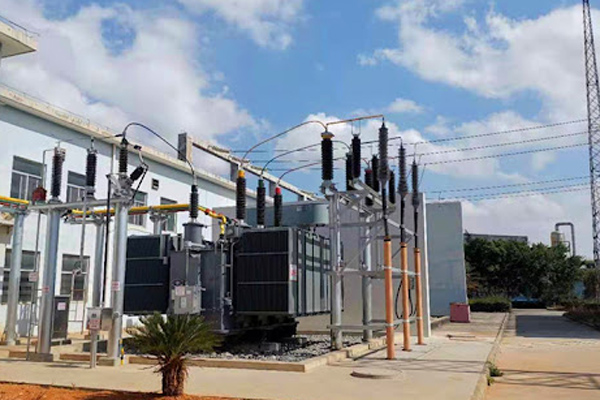
Substation transformers are large units used in power distribution substations to step down transmission voltages to distribution levels. They can be mounted in various ways, including ground‑level pads, platforms, or indoors.
-
Mounting Options: Ground‑level mounting may be either pad‑mounted compartmental type or unit substation type. Unit substation transformers can be used indoors or outdoors. Skid mounting options are available for various installation requirements.
-
Applications: Serve urban public power distribution systems, commercial customers requiring greater capacity, and industrial sites. They may be enclosed in a consumer’s building, housed in a concrete block town substation, or berm mounted.
-
Considerations: Larger units are often placed on overhead platforms in alleyways, alongside buildings, or on ground‑level pads protected by fencing. The platform must support the transformer’s weight and withstand seismic forces.
Platform-Mounted Transformers
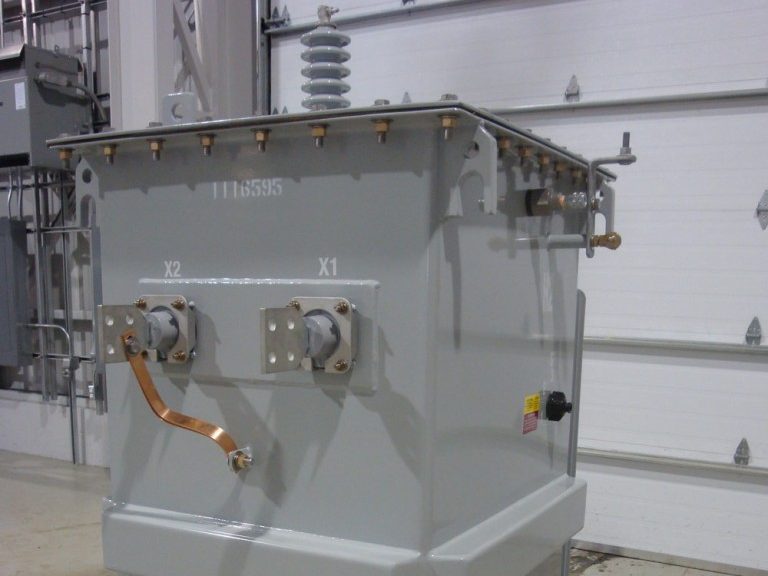
Platform-mounted transformers are supported above the ground by a platform structure, typically on two poles or a steel frame. This type is often used when a pole‑mounted unit is insufficient but a pad‑mounted installation is impractical.
-
Construction: The platform is fabricated from hot‑rolled channels, angles, and steel members, galvanized and field‑assembled by bolting. It supports transformers up to 500 kVA and is designed to withstand horizontal forces and overturning moments due to seismic effects.
-
Applications: Used in overhead power line construction where the transformer must be elevated. Larger units may be placed on overhead platforms in alleyways or alongside buildings.
-
Advantages and Disadvantages: Platform mounting offers less land occupation and keeps live parts high from the ground, reducing accident risk. However, the costs of two‑pole platform installations can be excessive, and the platforms may be visually unacceptable. New installations have largely been eliminated by three‑phase pad‑mounted transformers.
Ground-Mounted Transformers
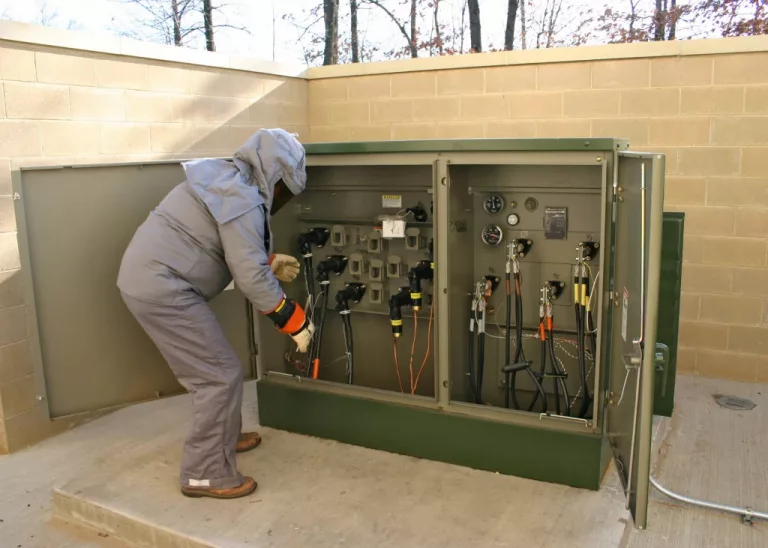
Ground-mounted transformers are installed directly on the ground, often on a concrete pad, and are synonymous with pad-mounted units in many contexts. They serve underground power networks.
-
Configuration: Fully enclosed, quiet, weatherproof, and tamperproof, making them the preferred choice for installation in public areas. Available in single‑phase, three‑phase, and grounding (zig‑zag) configurations.
-
Applications: Step down distribution voltage to secondary voltage for residential, commercial, and industrial loads. They are commonly used in urban distribution systems.
-
Advantages: Because all energized connection points are securely enclosed in a grounded metal housing, a padmount transformer can be installed in places that do not have room for a fenced enclosure. They also have lower purchase cost and fewer cooling issues compared to subsurface equipment.
Indoor-Mounted Transformers
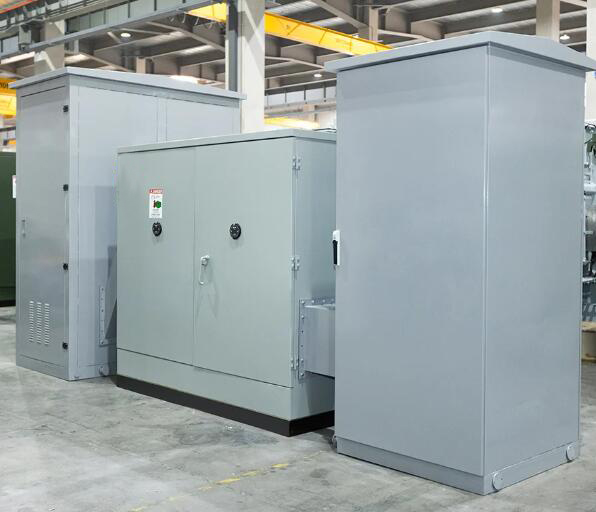
Indoor‑mounted transformers are typically dry‑type (cast resin or encapsulated) units installed inside buildings, often in electrical rooms or close to the load center.
-
Typical Types: Dry‑type transformers use insulation rather than liquid insulating oil, eliminating the need for oil containment systems and making them easier to install in building electrical rooms. They are ideal for indoor power distribution due to high efficiency, fire resistance, and environmental benefits.
-
Applications: Suitable for HVAC applications, signal and alarm systems, motor control circuits, and critical applications in tunnels, subways, and department stores where non‑flammability is required.
-
Advantages: Unlike liquid‑filled transformers, indoor installations do not require an automatic fire extinguishing system or fire vault, oil checking or replacing, or a liquid confinement area. They can be placed closer to the load center, reducing voltage drop and distribution losses.
-
Considerations: Their compact design allows flexible installation locations, but maintenance operations may be more difficult when mounted overhead. The reduced maintenance requirements of dry types are a definite advantage in such cases.
Underground Vault Transformers
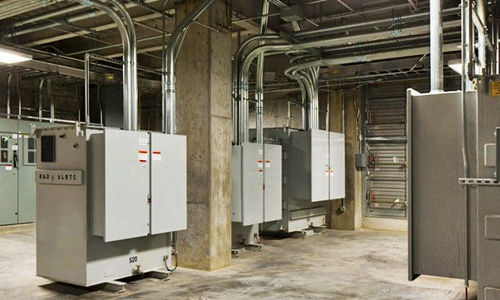
Underground vault transformers are installed in below‑grade concrete vaults, often in urban areas where space is limited and visual impact must be minimized.
-
Installation: The transformer may be suspended near the ceiling of the vault or installed at the base on feet, with clearance for lifting equipment. The vault is typically located under streets and sidewalks.
-
Applications: Used in underground distribution systems for concentrated commercial loads and tall buildings. The vaults are commonly located under streets and sidewalks or in other available locations.
-
Advantages: Completely out of sight and protected from windstorms, trucks, automobiles, and lawn mowers. Underground systems also minimize wind, ice, and tree limb damage and reduce lightning damage.
-
Disadvantages: High cost compared to overhead systems. Limited operational accessibility, a corrosive environment, and the challenge of dissipating heat from the transformer. Transformers and switches inside these rooms are usually down‑rated due to reduced heat dissipation.
Summary of Key Considerations
| Mounting Type | Typical Application | Key Advantage | Key Limitation |
|---|---|---|---|
| Pole‑Mounted | Rural/suburban overhead distribution | Low cost for sparse loads | Exposed to weather; limited capacity |
| Pad‑Mounted | Underground residential/commercial | Tamper‑resistant; safe in public areas | Burn hazard; security concerns |
| Substation | Power distribution substations | High capacity; flexible mounting | Large footprint; complex installation |
| Platform‑Mounted | Overhead lines needing elevated support | Less land occupation | Excessive cost; visual impact |
| Ground‑Mounted | Underground networks (synonymous with pad‑mount) | Enclosed; suitable for public areas | Same as pad‑mounted |
| Indoor‑Mounted | Building electrical rooms | No fire vault; close to load | Maintenance access |
| Underground Vault | Urban underground distribution | Out of sight; weather‑protected | High cost; heat dissipation |
Selecting the appropriate mounting type requires balancing technical requirements, environmental conditions, safety regulations, and economic considerations. For specific projects, consulting local utility standards and electrical codes is essential.