


Why Hospitals and Airports Prefer Dry-Type Transformers?
Dry-type transformers are widely utilized in applications such as local lighting, high-rise buildings, hospitals, airports, docks, and CNC machinery. Simply put, a dry-type transformer is a transformer in which the iron core and windings are not immersed in insulating oil.
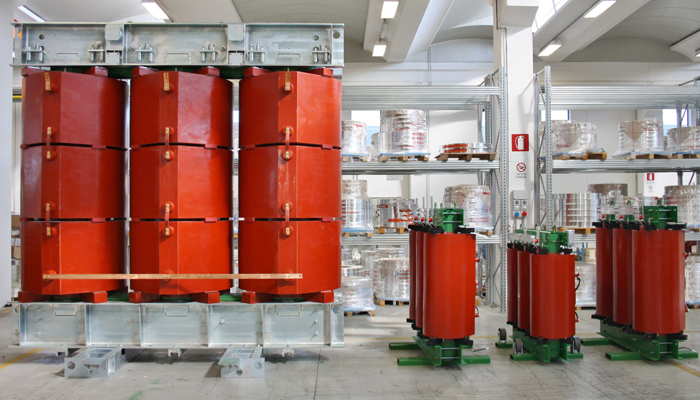
I. Cooling Methods
There are two cooling methods for dry-type transformers:
-
Natural Air Cooling (AN): Under natural air cooling, the transformer can operate continuously at its rated capacity for a long period.
-
Forced Air Cooling (AF): With forced air cooling, the transformer’s output capacity can be increased by 50%.
This method is suitable for intermittent overload operation or emergency overload operation. However, because load loss and impedance voltage increase significantly during overload, the transformer operates in a non-economical state and should not be subjected to prolonged continuous overload.
II. Structural Types
Based on the insulation structure, dry-type transformers are mainly divided into:
-
Solid Insulation Encapsulated Windings
-
Non-Encapsulated Windings
Between the two windings, the one with the higher voltage is the high-voltage (HV) winding, and the one with the lower voltage is the low-voltage (LV) winding. Regarding the relative position of the HV and LV windings, they can be classified as:
-
Concentric Type: The winding structure is simple and easy to manufacture. The vast majority of dry-type transformers use this structure.
-
Interlaced (Sandwich) Type: Mainly used for special transformers.
III. Structural Characteristics
-
Safe and Environmentally Friendly: Fireproof and non-polluting, can be installed directly at the load center.
-
Reliable Performance: Utilizes advanced technology, high mechanical strength, strong short-circuit withstand capability, low partial discharge, good thermal stability, long service life.
-
Energy-Saving and Maintenance-Free: Low loss, low noise, significant energy-saving effect, and maintenance-free operation.
-
Excellent Heat Dissipation and Overload Capability: Good heat dissipation performance, strong overload capacity. Forced air cooling can increase the capacity.
-
Good Moisture Resistance: Suitable for operation in high humidity and other harsh environments.
-
Intelligent Temperature Control: Can be equipped with a comprehensive temperature detection and protection system. An intelligent signal temperature control system automatically detects and cyclically displays the operating temperature of the three-phase windings, automatically starts and stops the cooling fans, and features alarm and trip functions.
-
Compact and Lightweight: Small footprint, low installation cost.
IV. Main Components and Processes
-
Core: Made of high-quality cold-rolled, grain-oriented silicon steel. The core joints use a 45-degree full miter structure, allowing the magnetic flux to pass through the direction of the silicon steel sheet joints, reducing loss and noise.
-
Winding Forms:
-
Wound type
-
Epoxy resin with quartz sand filling casting
-
Glass fiber reinforced epoxy resin casting (i.e., thin insulation structure)
-
Multi-strand glass fiber impregnated epoxy resin wound type
Currently, the third form is most commonly used as it effectively prevents cracking of the cast resin and improves equipment reliability.
-
-
High-Voltage Winding: Generally adopts a multi-layer cylindrical or multi-layer segmented structure.
V. Enclosure Types
-
Open Type: A common type where the active part is in direct contact with the atmosphere. Suitable for dry and clean indoor environments (ambient temperature 20°C, relative humidity not exceeding 85%). Cooling methods include natural air cooling and forced air cooling.
-
Closed Type: The active part is housed in a sealed enclosure without direct contact with the atmosphere. Mainly used in explosion-proof locations such as mines.
-
Cast Type: Uses epoxy resin or other resins as the main insulation. It has a simple structure, small size, and is suitable for small-capacity transformers.
VI. Operating Environment and Installation Points
-
Ambient Temperature: 0°C to 40°C, relative humidity <70%.
-
Altitude: Not exceeding 2500 meters.
-
Installation Clearance: Protect from rain, moisture, high temperature, high heat, or direct sunlight. Maintain a minimum distance of approximately 40 cm (1000px) between cooling vents and surrounding objects.
-
Environmental Requirements: Avoid use in locations with corrosive liquids, gases, dust, conductive fibers, or an abundance of metal fines.
-
Operating Conditions: Avoid use in locations with strong vibration or electromagnetic interference.
-
Storage and Transportation: Avoid prolonged inverted storage and transportation; protect from strong impacts.
-
Installation Method: Distribution transformers are key equipment in substations. A dry-type transformer without an enclosure can be installed directly on the ground, with protective barriers added around it. A dry-type transformer with an enclosure can also be installed directly on the ground. Refer to the national standard design drawing “03D201-4 Layout of 10/0.4kV Transformer Room and Installation of Common Equipment in Substation” for specific installation details.
VII. Temperature Control System
The safe operation and service life of a dry-type transformer largely depend on the reliability of the winding insulation. Winding temperature exceeding the insulation’s tolerance is a primary cause of transformer failure, making temperature monitoring and control crucial.
-
Automatic Fan Control: Temperature signals are collected via Pt100 thermal resistance temperature detectors pre-embedded in the hottest part of the LV winding. When the winding temperature reaches 110°C, the system automatically starts the fans for cooling; when the temperature drops to 90°C, the system automatically stops the fans.
-
Over-Temperature Alarm and Trip: Temperature signals are collected via PTC non-linear thermistors pre-embedded in the LV winding. When the winding temperature reaches 155°C, the system outputs an over-temperature alarm signal. If the temperature continues to rise to 170°C, the transformer can no longer operate safely. The system then outputs an over-temperature trip signal to the secondary protection circuit, causing the transformer to trip immediately.
-
Temperature Display System: Uses Pt100 thermal resistance sensors pre-embedded in the LV winding to measure temperature changes. It directly displays the temperature of each phase winding (three-phase巡检 and maximum value display, with historical maximum temperature recording capability). The maximum temperature can be output as a 4-20 mA analog signal for transmission to a remote computer (distance up to 1200 meters).
VIII. Protection Degrees (IP Codes)
-
IP20 Protective Enclosure: Prevents solid foreign objects larger than 12mm in diameter, such as rats, snakes, cats, and birds, from entering, thereby avoiding short circuits, power outages, and other severe faults. It provides a safety barrier for live parts.
-
IP23 Protective Enclosure: Suitable for outdoor installation. In addition to the protection offered by IP20, it also prevents water droplets entering at an angle up to 60° from the vertical. However, note that an IP23 enclosure reduces the transformer’s cooling capability; consideration must be given to de-rating its operating capacity when selecting this option.
IX. Overload Capability
The overload capability of a dry-type transformer depends on factors such as ambient temperature, initial load, insulation heat dissipation, and thermal time constant. For specific overload curves, please contact the manufacturer.
When utilizing its overload capability:
The calculated transformer capacity can be appropriately reduced. For example, fully consider the short-term impact overload characteristics of equipment like rolling mills or welders. For applications with non-uniform loads, such as residential areas with mainly nighttime lighting, cultural and entertainment facilities, or shopping malls with primarily daytime lighting and air conditioning, the transformer’s overload capability can be leveraged to select a smaller capacity, allowing it to operate near full load or under short-term overload during peak usage periods.
X. Routine Inspection Points
-
Check for abnormal sounds or vibrations.
-
Inspect for discoloration caused by local overheating, corrosive gases, etc., which may lead to creepage marks or carbonization on the insulation surface.
-
Verify that the forced air cooling system operates normally.
-
Check that HV and LV connections are not overheated, and cable terminations show no signs of leakage or creepage.
-
Ensure winding temperature rise does not exceed the specified limit for the insulation class used.
-
Inspect support insulators for cracks or discharge marks.
-
Check for looseness in winding clamping components.
-
Ensure indoor ventilation and core cooling ducts are not blocked by dust or debris, and that the core shows no signs of rust or corrosion.
XI. Differentiation from Related Equipment
-
Difference from a Frequency Converter (VFD): A frequency converter is primarily used to adjust the power supply frequency (e.g., 50Hz, 60Hz) to meet specific equipment requirements. A transformer, in this context, is mainly used to change the voltage level (typically step-down) for general power consumption needs.
-
Difference from Oil-Immersed Transformers: Dry-type and oil-immersed transformers are the two most commonly used types. Compared to oil-immersed transformers, dry-type transformers offer better fire resistance, making them suitable for locations with high fire safety requirements such as hospitals, airports, and stations. However, they generally have a higher cost and stricter requirements regarding environmental conditions (e.g., humidity, dust). Furthermore, the operational maturity of dry-type transformers is slightly less established than that of oil-immersed transformers.